
68 Verdi Street, Farmingdale
2300 Marcus Avenue, New Hyde Park
45 Seaview Boulevard, Port Washington
135 Spagnoli Road, Melville
Rising Interest Rates And Commercial Real Estate: A Primer
There has been much talk recently about what the Federal Reserve’s first interest rate hike since 2006 means for the U.S. economy as a whole. Here we take a look at the impact of rate hikes (current and future) on commercial real estate, examining first the prospective disadvantages and then the potential benefits.
Figuring this out isn’t straightforward, as interestrate changes have multiple impacts on commercial real estate (CRE). Further, the very causes of the Fed decision to raise interest rates may signal that other economic factors are at play, and these, too, may impact CRE.
Further complicating things, the timing of the rate hike coincides with the “maturity wall” of commercial mortgage-backed securities that need to be refinanced within the next two years. The maturity wall means there will be many borrowers who need refinancing in any case because their loans are maturing, while the rate hike could prompt those borrowers to seek out refinancing sooner rather than later.
It is worth noting that since the recent rate hike is small and the rate remains low – the quarter-point increase raises the target range to 0.25%-0.5% – the current hike may not have a massive effect on its own, but subsequent hikes are predicted for next year.
The bad news: Why rate hikes could be bad for CRE
Access to capital is one of the main drivers of any real estate deal, whether acquisition or new development. Higher interest rates mean that borrowers have to pay more in interest than they
would if they had borrowed the same amount of money before.
In the short term, these higher rates may prompt concern about future rate hikes and could drive borrowers to seek refinancing now, before rates rise again. Others may wait, and the higher rates could cause greater friction. In the extreme, higher interest rates may constrain property deals, as they can become a barrier to entry for borrowers, who now have to pay more to access money for loans or mortgages.
Cost of capital is a second consideration, as higher rates mean that the “rental price of money” has gone up. This could lead to borrowers paying more interest to lenders (a good thing for financial institutions). However, it could also lead borrowers to get smaller loans in the first place if they calculate that they would not be able to keep up with interest payments on a larger loan, forcing them to either put up more equity or target lower-priced properties. Further, riskier loans (like construction loans) and riskier assets may be even harder to finance efficiently, given the added risk premiums.
Higher capital costs could also increase default risks. These may be bad for lenders, too… that is, unless they are non-traditional “vulture” players employing a loan-to-own strategy and secretly hoping for defaults in order to seize properties. In an extreme situation, if these defaults start to spread, they can ultimately be bad for the economy as a whole.
Property valuations may also be affected. To explain, the copious amounts of cheap debt capital sloshing around the market have buoyed property values. An extended period of increasingly expensive debt, by contrast, may cause valuations to erode.
Property players are not the only ones affected by these changes; the lending institutions themselves may be affected as well. Knowing that higher interest rates erode both borrower net income and property value, lenders could respond by tightening lending standards or loan collateralization. For instance, they could limit lending in riskier markets or reduce the loan-to-value ratio, effectively meaning that they would require a greater proportion of money up front before issuing a loan.
They might also require more collateral to back up their loans. Current loan portfolios are potentially put at risk, not only new lending activity. While lenders can reduce their exposure on new loans by imposing stricter lending criteria, their exposure on existing loans could increase. As noted above, default risks can have an impact on all players.
If a property owner has a net operating income of $1 million and a capitalization rate of 3.75%, for instance, an interest rate hike of just 0.25% will trigger a cap rate hike (and a lower property value) that results in a 5% rise in the loan-to-value ratio, which is a key measure of risk. This could potentially push up a loan from a high but acceptable LTV of, say, 75% to a riskier LTV of 80%, which means that the borrower’s equity will be reduced to just 20% of an existing investment. In the pre-crisis bubble, many lenders were prepared to issue loans for particularly high LTVs.
171 Ames Court, Plainview
90 Remington Boulevard, Ronkonkoma
David vs. Goliath
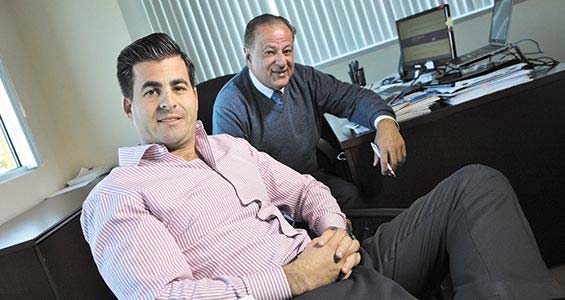
David vs. Goliath | Long Island Business News
Inked: Recent Long Island real estate deals
170 Michael Drive, Syosset
Cultural Arts Playhouse Academy leased 8,120 square feet at 170 Michael Drive in Syosset. The new location will feature two new performance spaces, an 80-seat main stage and a 50-seat black box area. Jeff Jurick of Woodburybased Premier Commercial Real Estate represented the tenant and the landlord, 170 Michael Drive LLC in the lease transaction.
170 Michael Drive, Syosset
Long Island Swimming leased 13,000 square feet at 170 Michael Drive in Syosset. The Garden City-based swim school and club is expanding its operations with two indoor pools at the new location. Michael Ventre of Windsor
Commercial Real Estate represented the tenant and David Chinitz of Park Place Realty Group represented landlord 170 Michael Drive LLC in the lease negotiations.
147 East Second St., Mineola
The law firm of Hannum Feretic Prendergast & Merlino, which specializes in insurance coverage and defense litigation, as well as construction defect, labor law, and trucking and product liability, leased 2,500 square feet office
space at 147 East Second St. in Mineola. The tenant was self-represented, while landlord Great Neck Saw Manufacturers was represented by Chuck Syage of Hunt Corporate Services in Plainview.
2115 Jericho Turnpike, Commack
Bar Louie, a national bar-and-grill restaurant concept, leased a 9,100-square-foot building on 2 acres at 2115 Jericho Turnpike. The site was formerly occupied by Chuck E. Cheese. Anthony Russo of Katz Associates represented the tenant and Jonathan Winzelberg of Sabre Real Estate Group represented landlord Cinron Associates in the lease transaction.